
 My CV
My CV ResearchGate
 ORCID
ORCID(in building)
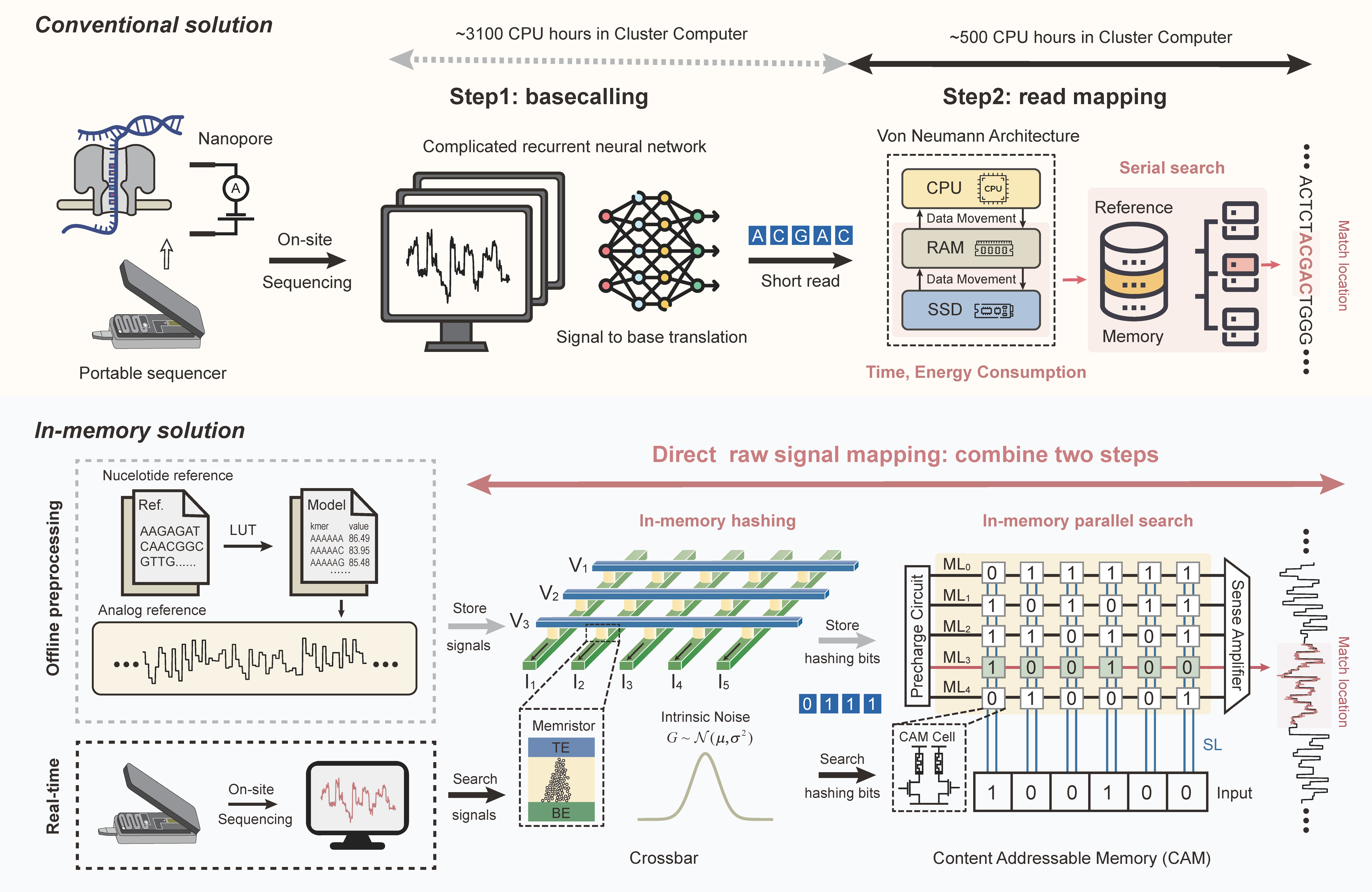
1. Nanopore signal mapping with locality-sensitive hashing in memristor hardware
Nanopore signal mapping using locality-sensitive hashing in memristor-based in-memory computing hardware. This work hardware-software co-design directly analyzed nanopore sequencing raw signals using in-memory computing hardware, effectively combining separate basecalling and read mapping.
References:
- P. He, et al., Real-time raw signal genomic analysis using fully integrated memristor hardware. Nature Computational Science 5, 940–951 (2025).
2. Fuzzy analog search in memristive analog content addressable memory for genomic search
This work proposed a fuzzy analog search paradigm that directly aligns sequencing signals against references by encoding the reference mean as the expected value and its standard deviation as the uncertainty width in analog content-addressable memory (CAM), enabling uncertainty-aware fuzzy matching that conventional digital hardware cannot support.

References:
- P. He†, R. Mao† et al., Fuzzy analog search in fully integrated memristive analog content addressable memory for efficient genomic analysis. manuscript under preparation.
3. Fully integrated 28 nm RRAM-based time-domain fault tolerant content-addressable memory
Fully integrated 28 nm time-domain edit distance tolerant content-addressable memory. It shift the input and accumulate the comparison results on the matchline through its discharge behavior, which computes the Shifted Hamming distance in the time domain.

References:
- P. He, et al., ShiftCAM: A Time-Domain Content Addressable Memory Utilizing Shifted Hamming Distance for Robust Genome Analysis. IEEE/ACM International Conference on Computer Aided Design (ICCAD), 2024.
- P. He, et al., A Fully Integrated 28 nm RRAM Time-Domain CAM for End-to-End Error-Tolerant Genomic Analysis. manuscript under preparation.
4. Hybrid CAM/CIM architecture with bio-inspired hashing for efficient retrieval
To eliminate unecessary ADC latency and energy consumption in in-memory retrieval-augmented generation, this work proposed a hybrid CAM/CIM architecture with bio-inspired locality-sensitive hashing (LSH) for multi-stage efficient retrieval.

- P. He, et al., BioHash-RAG: A Hybrid CAM/CIM Architecture with Bio-Inspired Locality-Sensitive Hashing for Efficient Retrieval-Augmented Generation. manuscript under preparation.